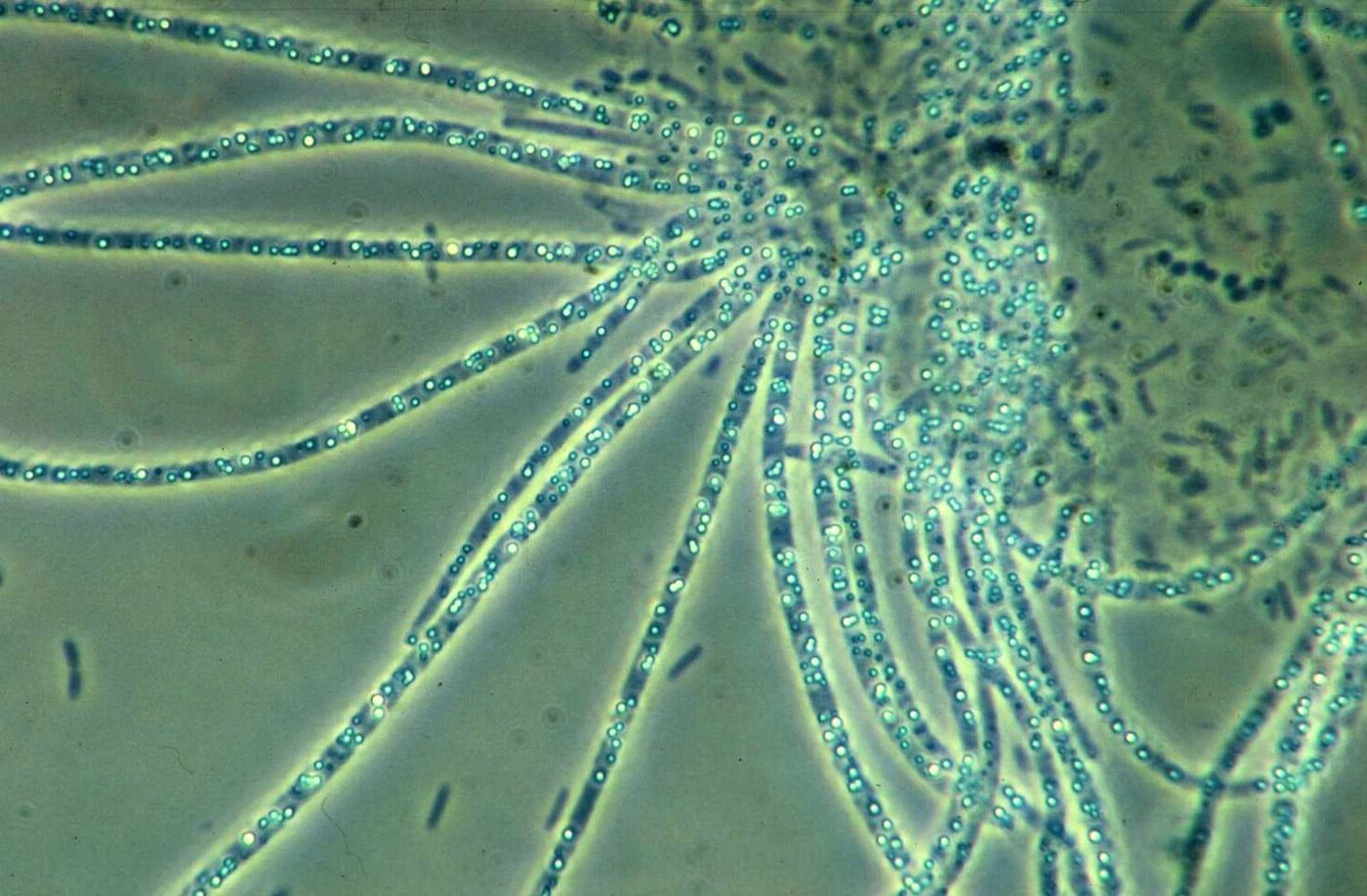
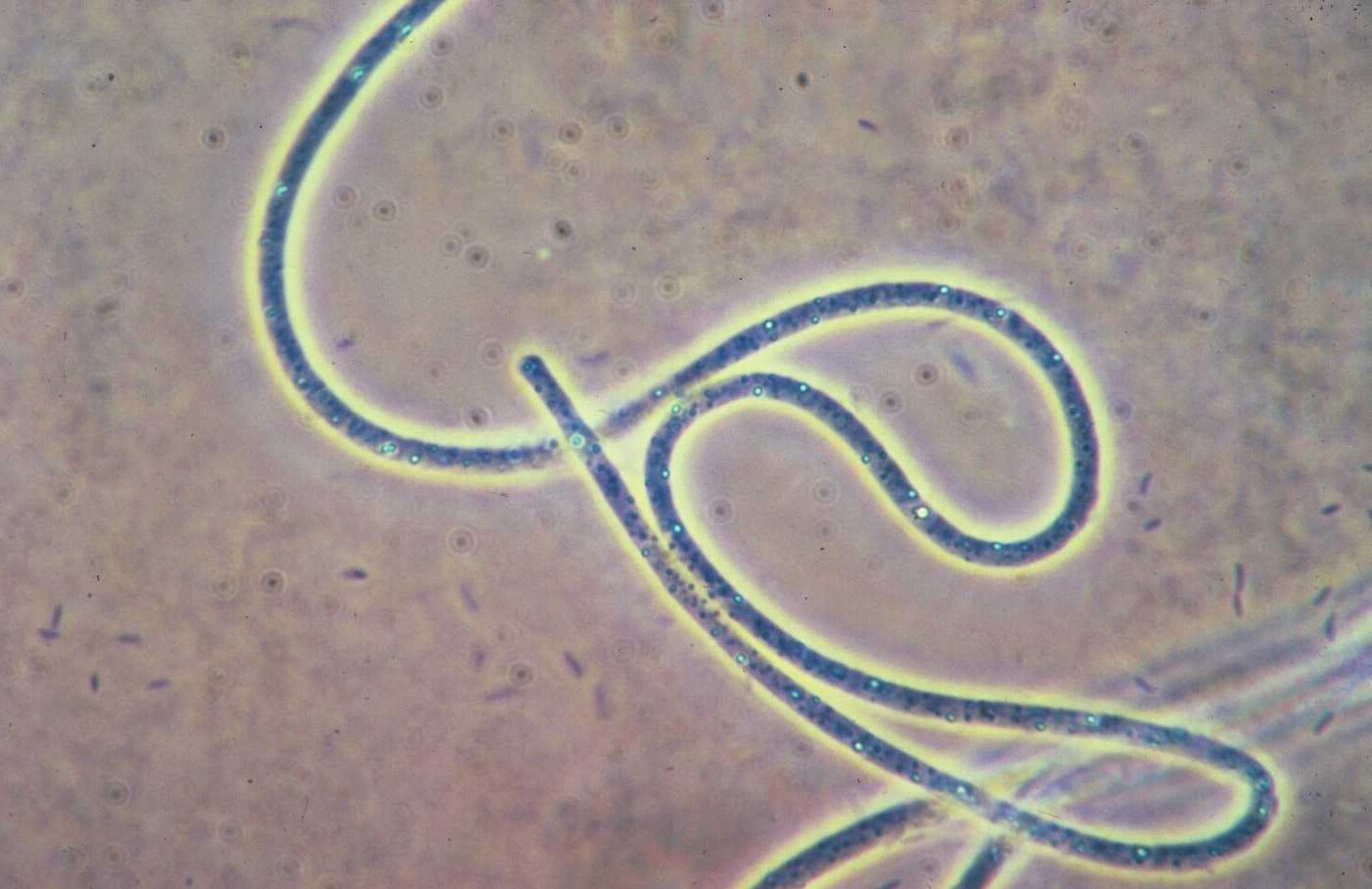
Long chains of bacteria. A few support floc; too many cause bulking and foam.
Sketch: filamentous organisms as typically seen at 100x to 400x. Not to scale.
Under the microscope
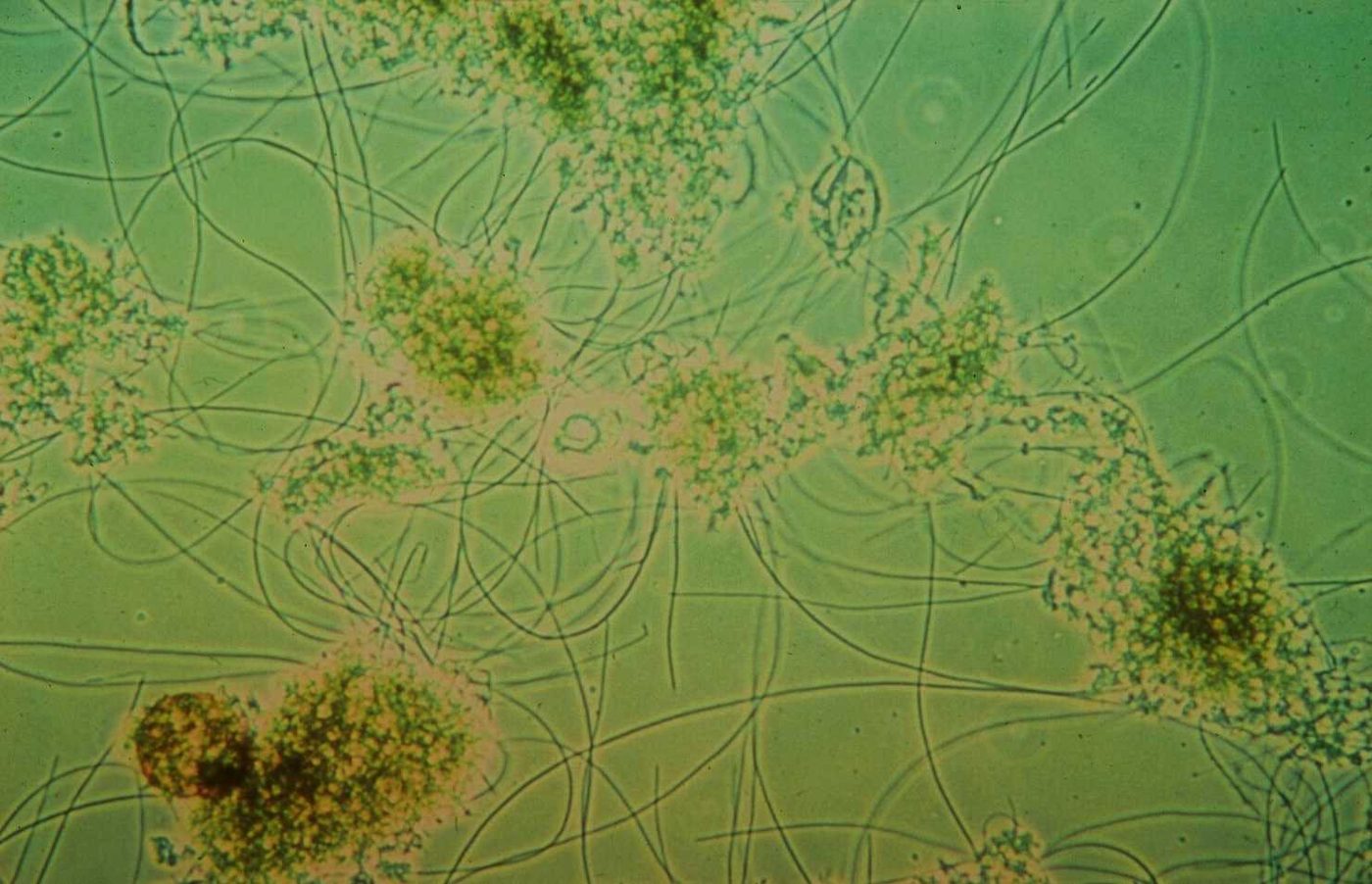
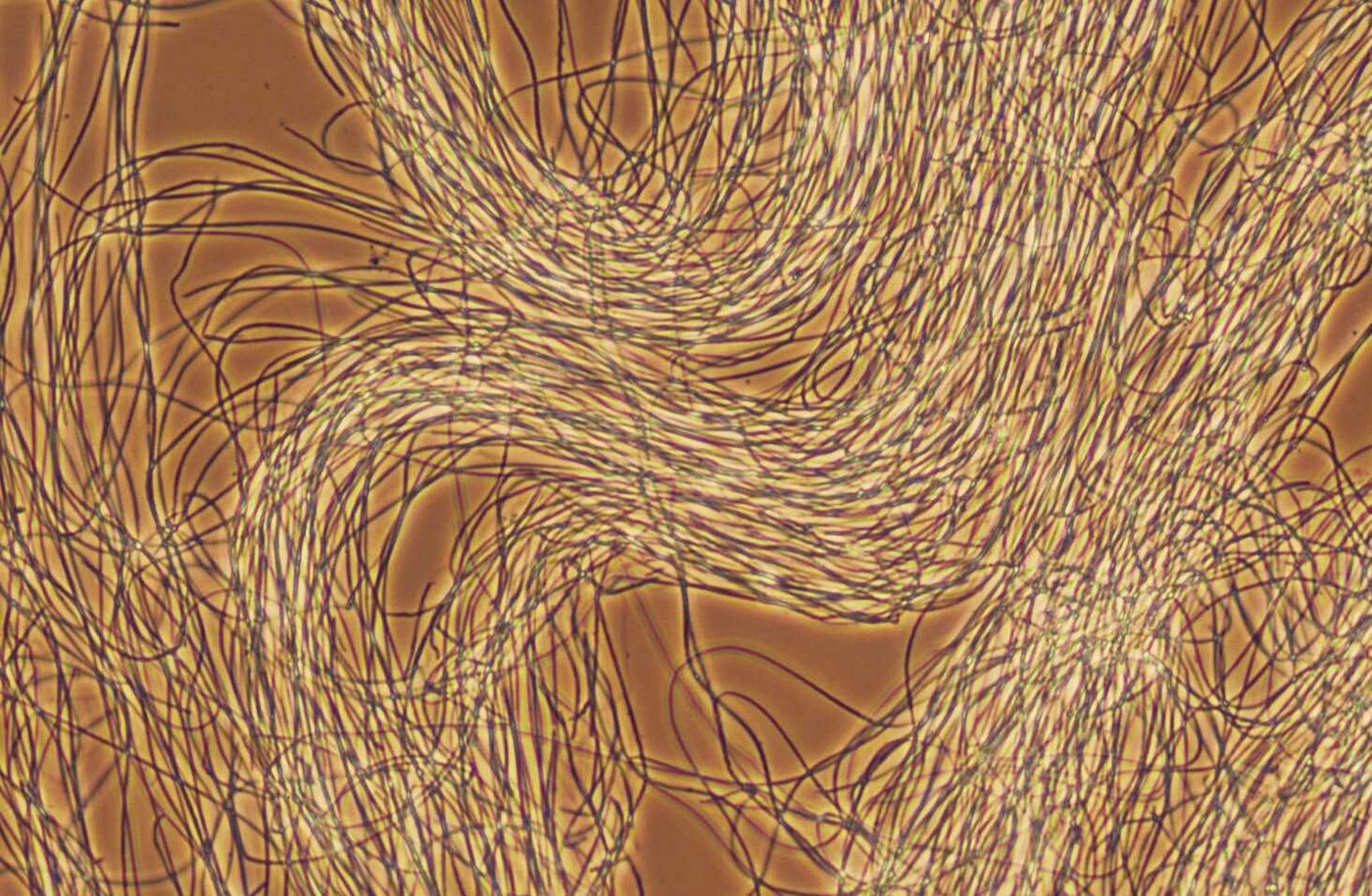
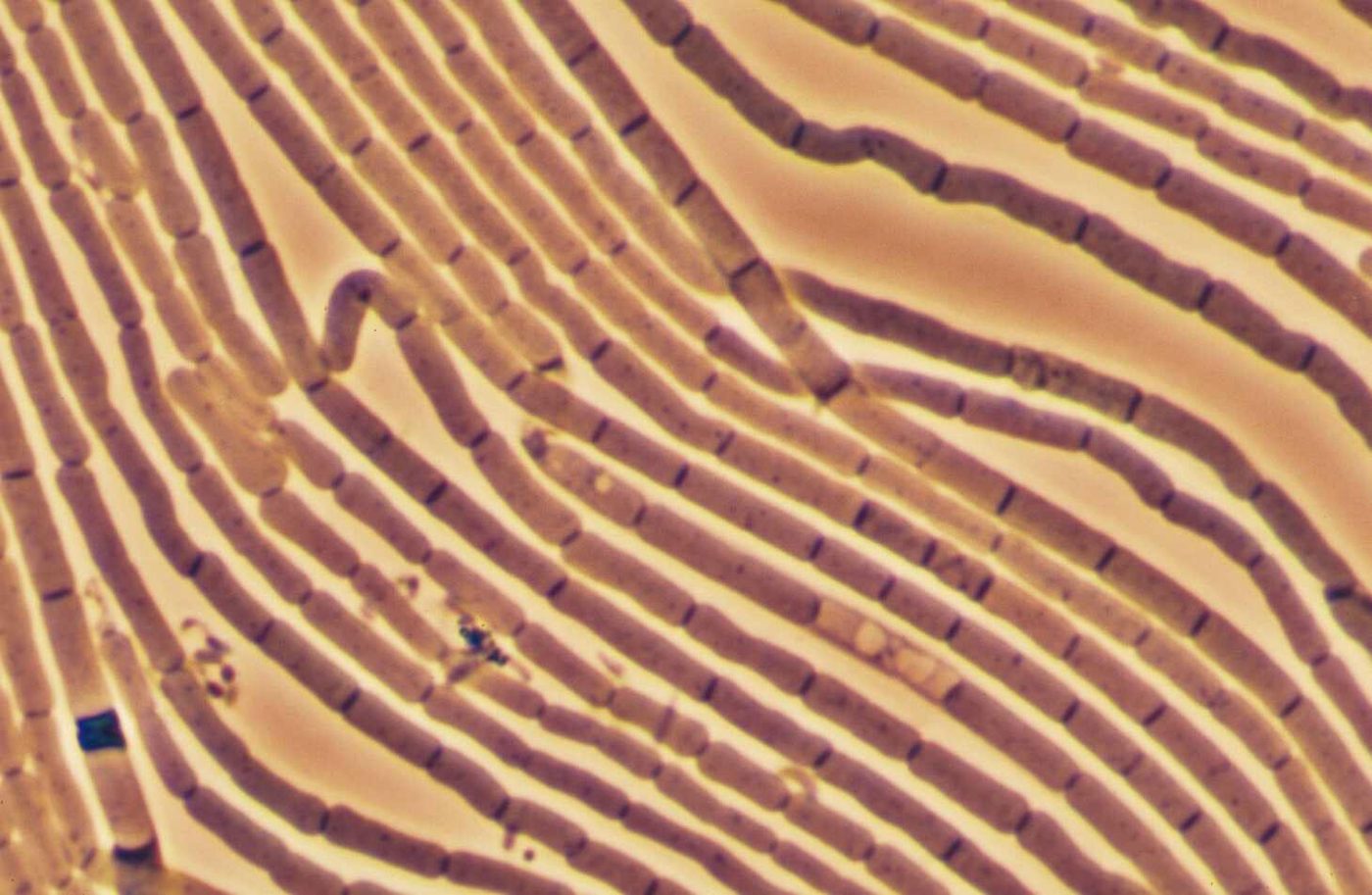
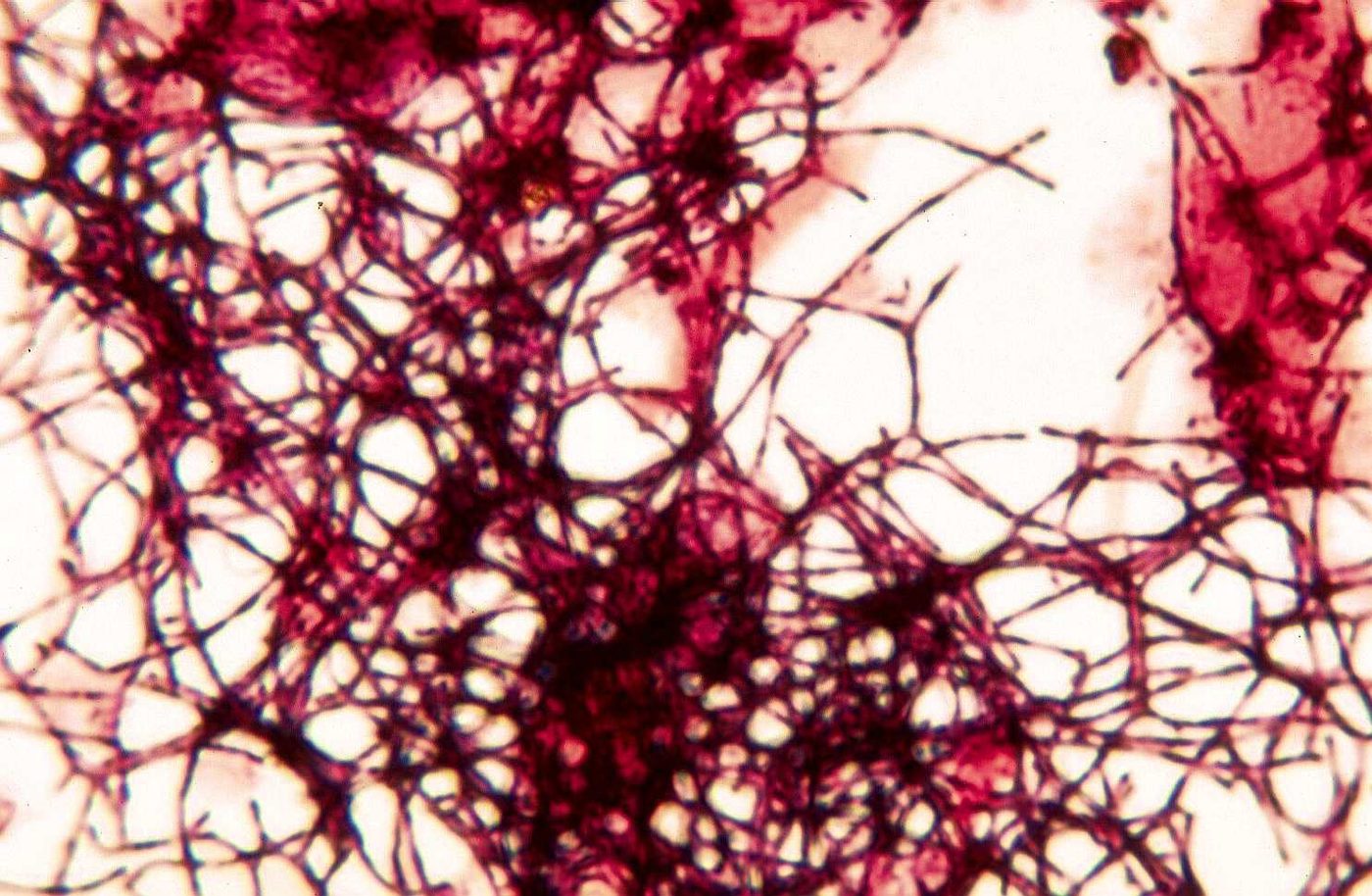
Interfloc bridging. Filaments bridging between flocs. 100x. What this indicates: Filaments bridging floc to floc hold the flocs apart and cause bulking: high SVI and a slow settling blanket.Type 021N. Type 021N in large numbers. Phase contrast, 200x. What this indicates: Type 021N points to nutrient deficiency or septic, high organic acid wastes.Sphaerotilus natans. Sphaerotilus natans, cells inside a clear sheath. Phase contrast, 1000x. What this indicates: S. natans is a classic low DO filament.Nocardioforms, Gram stain. Nocardioforms: Gram positive with true branching. 1000x. What this indicates: Nocardioforms go with grease, long SRT and thick brown foam on the aeration basin.Thiothrix. Thiothrix filaments radiating from a floc. Phase contrast, 1000x. What this indicates: Thiothrix points to septic wastes and sulfide, or to nutrient deficiency.Beggiatoa. Beggiatoa, a sulfur oxidizing filament that glides. Phase contrast, 400x. What this indicates: Beggiatoa indicates septicity and sulfide in the wastewater.
Photomicrographs from Brad Musick's microscope slide collection.
Capsules and sheaths. Bacteria with slime capsules (clear halos in India ink) and a sheathed filament with cells inside, an empty section and a false branch. What this indicates: Heavy capsule (slime) formation can cause viscous bulking, often from nutrient deficiency; a sheath and false branching help identify filaments such as S. natans.Original illustration for this site, not to scale.
Thread like chains of cells, from short (inside floc) to very long (extending out and bridging flocs).
Features used for ID: length, diameter, straight or curved or coiled, branching, sheath, attached growth, cell shape, sulfur granules, Gram and Neisser stain reaction.
Rate abundance 0 (none) to 6 (excessive). At 4 (very common) or more, settling is usually affected.
What it may indicate
Low DO: S. natans, Type 1701, H. hydrossis.
Low F/M: M. parvicella, Types 0041, 0675, 1851, 0092.
Septicity and sulfide: Thiothrix, Type 021N, Beggiatoa.
Nutrient deficiency: Thiothrix, Type 021N.
Grease and long SRT: Nocardioforms, M. parvicella (often with brown foam).
What process data to check next
DO at 15 minute resolution, especially at peak load.
F/M and SRT.
Influent septicity: sulfide, ORP, hauled waste.
Nutrients: ammonia and ortho-P leaving aeration.
Grease loading and foam.
One slide is a snapshot. Look at trends over several days and compare with SRT, F/M, DO, SVI and effluent quality before you change anything.