A free process control resource from Wastewater Solutions, Inc.help@ActivatedSludge.com  |  503-701-2766
ActivatedSludge.comPractical wastewater process control

Amoebae

Shape changing naked amoebae and shelled (testate) amoebae.

Amoeba sketchA naked amoeba with flowing pseudopods and a testate amoeba with a shell.testateLine sketch for orientation only. Not to scale.
Sketch: amoebae as typically seen at 100x to 400x. Not to scale.

Under the microscope

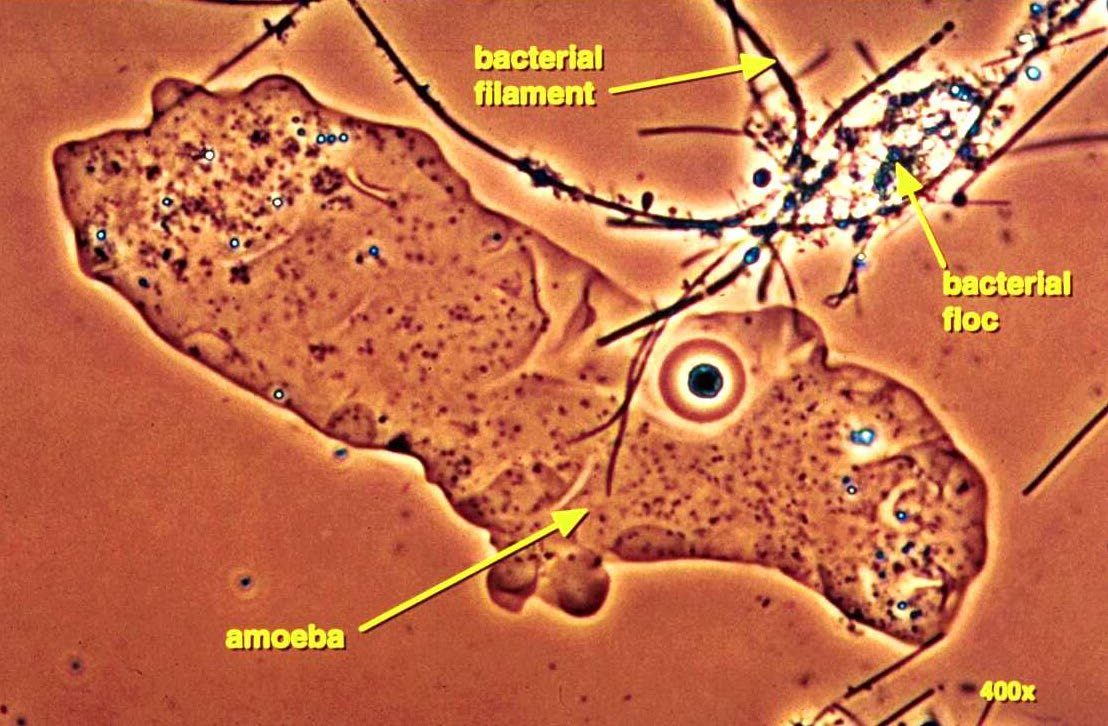
Large naked amoeba next to bacterial floc and a bacterial filament, labeled, phase contrast at 400x
Naked amoeba. Large naked amoeba beside a bacterial floc and filament. Phase contrast, 400x. What this indicates: Naked amoebae in numbers suggest a young sludge, a startup or recovery after an upset. One or two on a slide is normal.

Photomicrographs from Brad Musick's microscope slide collection.

See all 53 photos in the gallery

Illustrated

Naked and testate amoebaeLeft: a naked amoeba with pseudopods, nucleus, food vacuoles and a contractile vacuole. Right: two testate amoebae, a round brown Arcella shell and a vase shaped Euglypha shell made of plates, with pseudopods extending.Naked and testate (shelled) amoebaepseudopodnucleusfood vacuolescontractile vacuoleArcella (side view)EuglyphaNaked amoeba: young sludge, startup, recoverySlow, shape changing, easy to miss at 100xTestate amoebae: long SRT, low F/MOften with full nitrification
Naked and testate amoebae. A naked amoeba with pseudopods and vacuoles, and two shelled (testate) amoebae, Arcella and Euglypha. What this indicates: Many naked amoebae suggest a young sludge or a recovery from upset; testate amoebae suggest a long SRT, low F/M and often full nitrification. Original illustration for this site, not to scale.

See all microscopy illustrations

What you see

  • Naked amoebae: shapeless cells that move by flowing cytoplasm (pseudopods). Slow moving, often easy to miss.
  • Testate amoebae (Arcella, Euglypha): amoebae in a round or vase shaped shell, often brown, with pseudopods extending from an opening.

What it may indicate

  • Naked amoebae in large numbers: young sludge, startup, recovery after an upset, high F/M or low DO.
  • Testate amoebae: typically long SRT, low F/M, stable nitrifying sludge, sometimes extended aeration.

What process data to check next

  • SRT and F/M: are you running very young or very old sludge?
  • DO profile.
  • Recent upset or washout.
  • Ammonia: testate amoebae often coincide with full nitrification.
One slide is a snapshot. Look at trends over several days and compare with SRT, F/M, DO, SVI and effluent quality before you change anything.