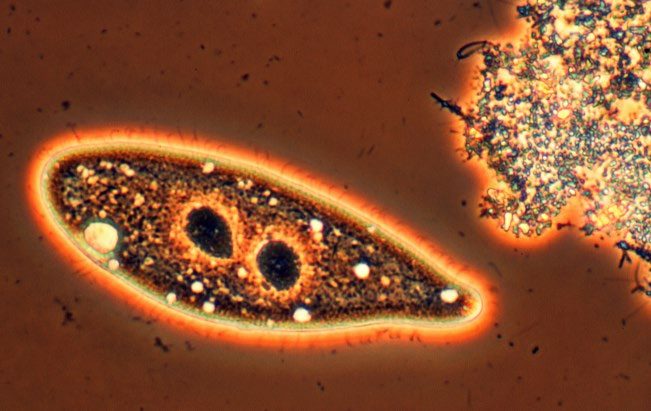
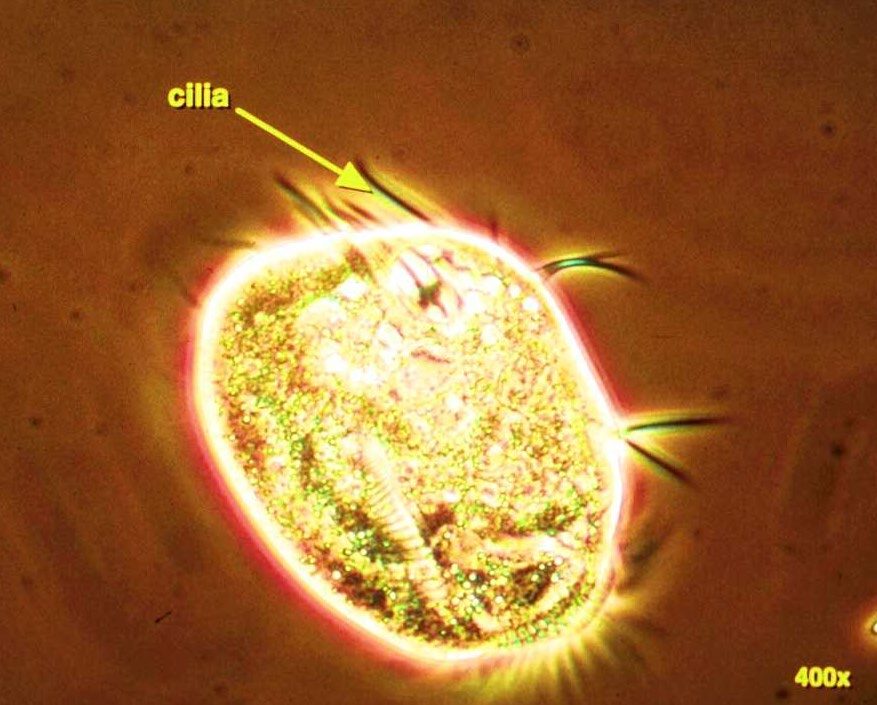
Ciliates that swim between flocs eating dispersed bacteria. Paramecium, Litonotus, Aspidisca (crawler).
Sketch: free-swimming ciliates as typically seen at 100x to 400x. Not to scale.
Under the microscope
Free-swimming ciliate. Slipper shaped free-swimming ciliate beside a floc. Phase contrast. What this indicates: Free swimmers feed on dispersed bacteria. Many of them often means a younger sludge or a cloudy background.Crawling ciliate. Crawling ciliate with its cirri (fused cilia) visible. Phase contrast, 400x. What this indicates: Crawlers grazing on floc, together with stalked ciliates, suggest a stable, well flocculated sludge.
Photomicrographs from Brad Musick's microscope slide collection.
The six protozoa groups. Original line drawings of amoebae, flagellates, free-swimming, crawling and stalked ciliates and suctorians. What this indicates: Which group you see most of hints at sludge age: amoebae and flagellates for young sludge, crawling and stalked ciliates and suctorians for mature sludge.Original illustration for this site, not to scale.