Bell shaped ciliates attached to floc by a stalk. Vorticella, Epistylis, Opercularia, Carchesium.
Sketch: stalked ciliates as typically seen at 100x to 400x. Not to scale.
Under the microscope
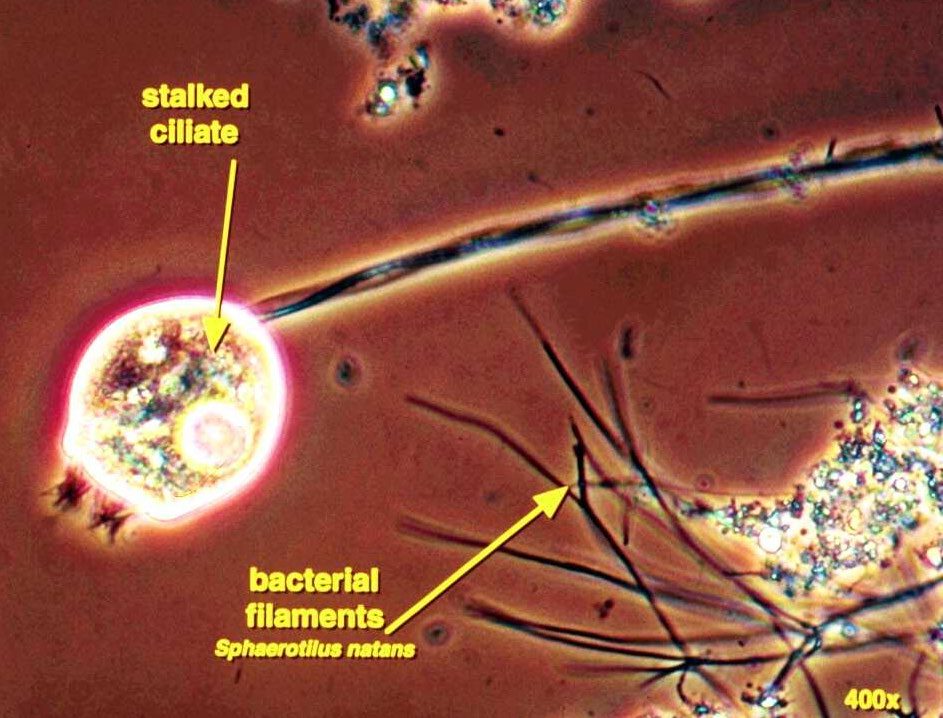
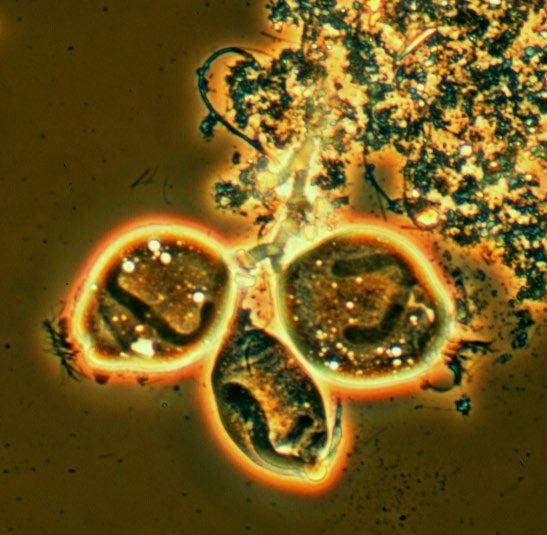
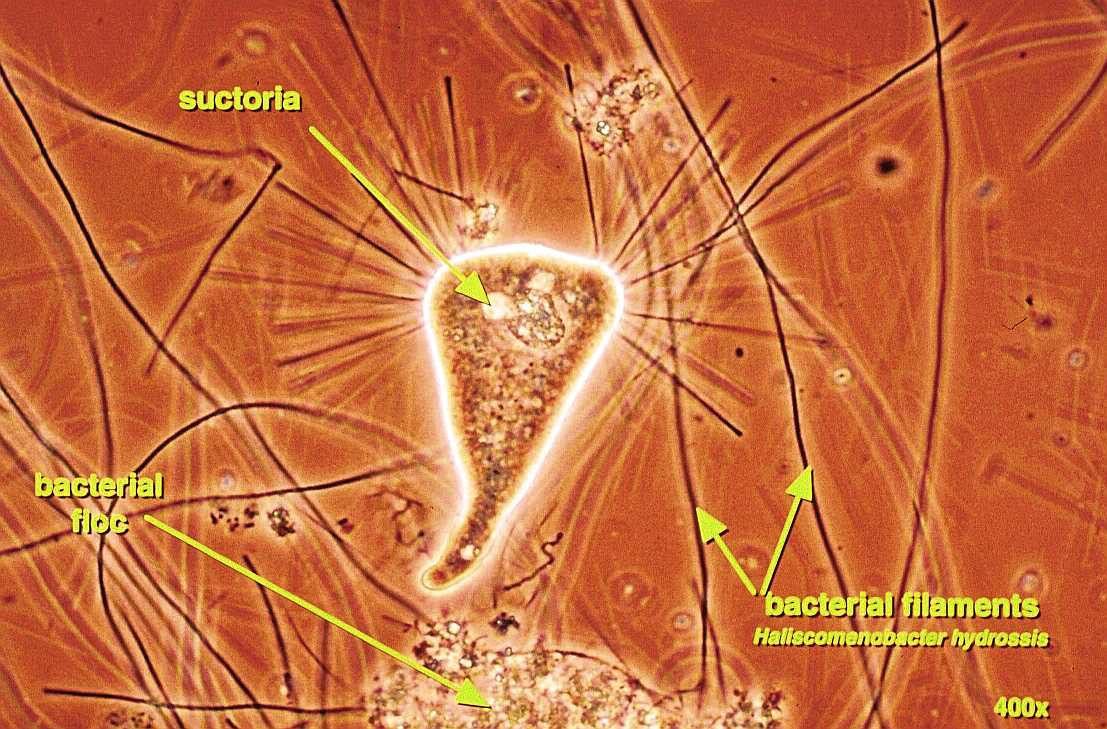
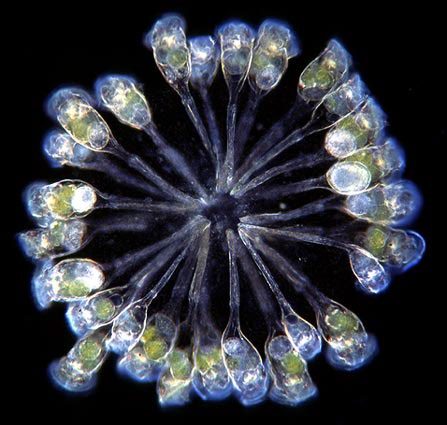
Stalked ciliate. Stalked ciliate attached by its stalk, with Sphaerotilus natans filaments in the same field. Phase contrast, 400x. What this indicates: Stalked ciliates point to a stable, mature sludge. S. natans in the same field is a low DO indicator, so check the DO profile.Stalked ciliates on floc. A group of stalked ciliates on the edge of a firm floc. Phase contrast. What this indicates: Healthy, open bells on firm floc usually go with good settling and a clear supernatant.Suctorian. Suctorian (a stalked relative of the ciliates that catches prey with tentacles) among Haliscomenobacter hydrossis filaments. Phase contrast, 400x. What this indicates: Suctorians feed on other protozoa and usually show up with stalked ciliates in a stable, older sludge.Colonial stalked ciliates. A colony of stalked ciliates whose stalks branch from a single base, forming a rosette. Darkfield illumination. What this indicates: Large colonies of stalked ciliates take time to build, so they point to a stable, mature sludge with a steady load and good DO.
Photomicrographs from Brad Musick's microscope slide collection.
The six protozoa groups. Original line drawings of amoebae, flagellates, free-swimming, crawling and stalked ciliates and suctorians. What this indicates: Which group you see most of hints at sludge age: amoebae and flagellates for young sludge, crawling and stalked ciliates and suctorians for mature sludge.Original illustration for this site, not to scale.
Bell or vase shaped cells, about 50 to 150 microns, attached to floc by a stalk.
A ring of cilia at the top beats to draw in bacteria; you can see the water current at 100x and 400x.
Single forms (Vorticella) have a contractile stalk that coils like a spring. Colonial forms (Epistylis, Opercularia, Carchesium) branch from one stalk.
Under stress they close up, detach from the stalk, or swim free as a "telotroch".
What it may indicate
Generally a stable, mature sludge with good floc and low effluent turbidity.
Large numbers of Vorticella with good floc: healthy conventional operation.
Colonial Epistylis and Opercularia in large numbers: often longer SRT; Opercularia is sometimes associated with stress or low DO.
Closed, detached or dying stalked ciliates across the slide: possible toxicity, low DO, or a sudden load or pH change.
What process data to check next
SRT and F/M trend: has anything changed?
DO by zone and time of day.
Effluent turbidity and TSS.
If they suddenly disappear: influent pH, conductivity, industrial discharges, OUR and SOUR.
One slide is a snapshot. Look at trends over several days and compare with SRT, F/M, DO, SVI and effluent quality before you change anything.